MANUFACTURING KNOWLEDGE AI

Manufacturing Knowledge
as an Asset

Apparel Supply Chain
Knowledge as an Asset

One data pipeline connects vendor HQ and overseas factories.
Master data is kept as SSOT from order intake to finished-goods shipment.

O1 // THE GAP

Head & Hands,
Different Countries

3-Party Disconnect

Labor-intensive manufacturing depends on people, so it is sensitive to labor cost, and 3-party trade (buyer, vendor, factory) is the most efficient structure.
Each party specializes, but the three organizations do not communicate well.

  1. 1-AWhy Trade Splits Into Three
  2. FIG.Three parties, three roles
  3. 1-BThe Key: Connection
  4. FIG.Three systems, one manual relay
  5. 1-CCost of Disconnect
  6. Summary3-Party Split Is Necessary
BUYERINTERMEDIARY TRADE COMPANYPRODUCTION SITESHIPMENTEUROPEAMERICASEUROPEAMERICAS
1-A. Why Trade Splits Into Three

Orders, Sourcing and Production in Different Countries

The buyer initiates the order.
Its goal is to supply goods that match consumer demand on time, through volume or multi-style orders.
The vendor handles sourcing: order management, costing, materials & trims, production planning and trade.
Most are in Northeast Asia: Korea, China, Hong Kong, Taiwan.
The factory cuts, sews, inspects, packs and ships, exporting worldwide.
Three parties, three roles
BUYER01
Fashion, Furniture, Toy, etc.Supplies sewn consumer goods to market: apparel, bags, footwear, cushions, bedding, towels, plush toys, seat covers.
INTERMEDIARY TRADE COMPANY02
Vendor, Agency, Promotion, etc.Sources orders taken from the buyer to meet delivery, price and quality terms.
PRODUCTION SITE03
Factory, OutsourcingMakes and ships finished goods to the vendor order specification.
1-B. The Key: Connection

3-Party Time, Language, System Gaps

The vendor system and the factory ledger are not connected.
What links them is .xlsx and .pdf attachments, email text and messenger apps.
Where people retype by hand is the real link in the supply chain.
Three systems, one manual relay
RECORD
RECORD
RECORD
RECORD
RECORD
RECORD
RECORD
RECORD
RECORD
RECORD
RECORD
RECORD
RECORD
RECORD
RECORD
RECORD
RECORD
RECORD
RECORD
RECORD
RECORD
RECORD
RECORD
RECORD
RECORD
RECORD
RECORD
RECORD
RECORD
RECORD
01BuyerUTC-5 ~ +1 · EN
PLMPortal.pdf TechPack.xlsx QC standardEmail body
02VendorUTC+8 ~ +9 · KO · ZH
ERP.xlsx costing.pdf POEmail attachmentMessenger
03FactoryUTC+6 ~ +7 · VI · ID · BN
Paper ReportWhiteboard.jpg floor photosMessengerScanned image
Time Gap8-17 hours.
A question and reply take over 1 business day
Language3 or more languages.
Operation terms and control rules differ in each
Systems3 or more separate data stores.
All data transfer is manual
Manual Re-EntryThe vendor retypes sizes, quantities and color codes from the .pdf TechPack into ERP
Copy > PasteThe factory copies the .xlsx reference table onto whiteboards and paper reports
Unit & Notation GapInches in buyer specs and cm in house standards mix, causing conversion errors
Missed UpdatesMessenger and email updates miss the reference table and are patched ad hoc
Unversioned ResendsReference tables for one style circulate in several copies, only renamed
RECORD
RECORD
RECORD
RECORD
RECORD
RECORD
RECORD
RECORD
RECORD
RECORD
RECORD
RECORD
RECORD
RECORD
01BuyerUTC-5 ~ +1 · EN
PLMPortal.pdf TechPack.xlsx QC standardEmail body
Unit & Notation GapInches in buyer specs and cm in house standards mix, causing conversion errors
Manual Re-EntryThe vendor retypes sizes, quantities and color codes from the .pdf TechPack into ERP
02VendorUTC+8 ~ +9 · KO · ZH
ERP.xlsx costing.pdf POEmail attachmentMessenger
Missed UpdatesMessenger and email updates miss the reference table and are patched ad hoc
Copy > PasteThe factory copies the .xlsx reference table onto whiteboards and paper reports
03FactoryUTC+6 ~ +7 · VI · ID · BN
Paper ReportWhiteboard.jpg floor photosMessengerScanned image
Unversioned ResendsReference tables for one style circulate in several copies, only renamed
Time Gap8-17 hours.
A question and reply take over 1 business day
Language3 or more languages.
Operation terms and control rules differ in each
Systems3 or more separate data stores.
All data transfer is manual
01Buyer
PLMPortal.pdf TechPack
02Vendor
ERP.xlsx costing.pdf PO
03Factory
Paper ReportWhiteboard.jpg floor photos
MANUAL RELAY
01 → 02
Manual Re-EntryMasses of TechPack data retyped into ERP
02 → 03
Copy > PasteReference table copied to whiteboard and paper
01
Unit & Notation GapInch/cm mix, conversion errors
02
Missed UpdatesMessenger/email updates added ad hoc
03
Unversioned ResendsRenamed copies of one table in circulation
Systems
3 or more separate data stores. All data transfer is manual
1-C. Cost of Disconnect

Five Losses, All Found Late

Spec entry errors, version conflicts, late output visibility, cost settlement disputes, knowledge loss.
All five are found long after the point where they could be handled.
LossWhat HappensWhen It Surfaces
Spec Entry ErrorThe vendor retypes .pdf TechPack sizes, quantities and colors into ERP, and a typo orders the wrong fabric specAt change request
Version ConflictTwo or more .xlsx reference tables for one style circulate. The factory cuts by one, and inspection uses anotherOn QC failure
Late Output DataPaper reports arrive a day late by photo and messenger, totals are weekly, and delays show just before shipmentPre-shipment
Cost DisputesThe three organizations each calculate from FOB down to CM, and at settlement the three numbers do not matchMonth-end closing
Knowledge LossOperation, spec and issue history stays in personal mailboxes and folders and is not reused on the next orderAt staff change

Division of labor in 3-party trade is essential.
But the three organizations must decide on the same data on one platform.

The starting point: all three organizations share the latest data in real time, whatever the distance.

O2 // ORDER LIFECYCLE

One Order,
Six Steps

Order Lifecycle

One order passes six stages from intake to shipment.
At each stage the same values are retyped into each tool.

  1. 2-ASix Stages of an Order
  2. FIG.Six stages, six tools, several open at once
  3. 2-BSame Values Retyped in Every Tool
  4. SummaryRemove Re-Entry, Not Tools
2-A. Six Stages of an Order

Records Scattered by Stage Owner

Order intake starts in the buyer PLM and email, then moves to the vendor spreadsheet and ERP.
Costing is done in a spreadsheet and re-entered in ERP, and factory CM goes back and forth by email.
Factory production and QC reports are split across handwritten reports, spreadsheets and messenger.
THE TOOL MAP

One stage needs many documents and software open at once.
The order is held together by the tacit knowledge of the staff.

Six stages, six tools, several open at once
ORDER STAGE →RECORD TOOLPLMERPSpreadsheetEmailMessengerPaper · Whiteboard00INTAKEBUYER · VENDORTECHPACK · SPECORDER ENTRYORDER SHEETP/O01COSTINGVENDOR · FACTORYQUOTATIONCOST SHEETCM REQUEST02MATERIALVENDOR · FACTORYP/O / BOMMATERIAL LISTP/O SENDETA CHASE03PRODUCTIONFACTORY · VENDORLINE PLANPHOTO REPORTDAILY OUTPUT04INSPECTIONFACTORY · BUYERQC UPLOADAQL REPORTREPORT SENDQC LOG05SHIPPINGVENDOR · FACTORYASNINVOICE / PLSHIP QTYDOC SENDRECORD TOOL →PLMERPSpreadsheetEmailMessengerPaper ·Board00INTAKEBUYER · VENDORTECHPACK · SPEC · ORDER ENTRY · ORDER SHEET · P/O01COSTINGVENDOR · FACTORYCOST SHEET · QUOTATION · CM REQUEST02MATERIALVENDOR · FACTORYP/O / BOM · MATERIAL LIST · P/O SEND · ETA CHASE03PRODUCTIONFACTORY · VENDORDAILY OUTPUT · LINE PLAN · PHOTO REPORT04INSPECTIONFACTORY · BUYERAQL REPORT · QC UPLOAD · REPORT SEND · QC LOG05SHIPPINGVENDOR · FACTORYINVOICE / PL · ASN · SHIP QTY · DOC SEND
  1. 00INTAKE
    • PLMTECHPACK · SPEC
    • ERPORDER ENTRY
    • SpreadsheetORDER SHEET
    • EmailP/O
  2. 01COSTING
    • SpreadsheetCOST SHEET
    • ERPQUOTATION
    • EmailCM REQUEST
  3. 02MATERIAL
    • ERPP/O / BOM
    • SpreadsheetMATERIAL LIST
    • EmailP/O SEND
    • MessengerETA CHASE
  4. 03PRODUCTION
    • Paper · WhiteboardDAILY OUTPUT
    • SpreadsheetLINE PLAN
    • MessengerPHOTO REPORT
  5. 04INSPECTION
    • SpreadsheetAQL REPORT
    • PLMQC UPLOAD
    • EmailREPORT SEND
    • Paper · WhiteboardQC LOG
  6. 05SHIPPING
    • ERPINVOICE / PL
    • PLMASN
    • SpreadsheetSHIP QTY
    • EmailDOC SEND
2-B. Same Values Retyped in Every Tool

Fragmented Software, Same Data Entered in Every Tool

Order number, style, quantity and delivery date are master data that keep the same values through all six stages.
But the software tools are not connected, so a person retypes them at every handoff to the next stage.
StageWhat Is Open at One StageTools
INTAKEThe vendor takes the TechPack from PLM and the P/O from email, and copies the same values to the order sheet and ERP order entry4 tools
COSTINGThe cost sheet is built in a spreadsheet, the confirmed price is re-entered in ERP, and CM goes by email3 tools
MATERIALERP issues the P/O and BOM, requirements and receipts go in spreadsheets, the purchase order goes by email, and delivery is checked by messenger4 tools
PRODUCTIONWork orders and daily reports run on paper, the line plan is in a spreadsheet, and output is sent as photos3 tools
INSPECTIONInspection logs are on paper, reports in spreadsheets, approval by email, and buyer submission in the PLM portal4 tools
SHIPPINGInvoice and packing list come from ERP, shipped quantity is checked in a spreadsheet, documents go by email, and ASN is entered in the buyer PLM portal4 tools

The fix: remove re-entry, not tools.

When every tool reads and writes the same master data directly, no value is left to retype.

O3 // FLOOR DATA

The Floor,
in Numbers

Production Data

Floor numbers still come from a person timing a few cycles with a stopwatch and writing quantities on a daily report.
Values differ by who measured and when, and they become the cost of the next order.

  1. 3-AHow Floor Numbers Are Made Today
  2. FIG.Sampling ends in a report, measurement ends in an action
  3. 3-BAuto-Measurement Impact
  4. SummaryMeasuring Proves Factory Capability
3-A. How Floor Numbers Are Made Today

Sample Readings Used as the Standard for All

An industrial engineer sets operation time by timing a few cycles with a stopwatch.
The supervisor writes output on a paper report, and the office totals it a day later.
These values become the SMV, and the SMV becomes the quote and line target of the next order.
THE MEASUREMENT

Full measurement detects a slowdown within the shift
and turns it into floor action.

Sampling ends in a report, measurement ends in an action
3-B. Auto-Measurement Impact

Comparison Needs One Measuring Basis

Full measurement makes values the same way on each line and operation.
So values by date, line and order can be compared on the same basis.
Comparable values become the basis for SMV and costing.
Measured ItemAutomaticConventional
Output QtyReads each operation completion signal from the machinePaper Report
Operation TimeLogs start and end time of work per operationTimed Sample
Work MotionOnly joint coordinates are extracted from video for judgment. Raw video is not keptVisual Check

Measuring proves factory capability.

Values built on one basis prove factory capability in numbers, and those numbers back the cost of the next order.

O4 // COST DESIGN

Sourcing & Production,
One Cost Structure

15-30%
Share of CM in FOB cost
2-5%
Factory net margin: a CM error is a direct loss
10-25pp
Plan vs actual efficiency: main cause of quote error

From public industry data (ITC apparel costing guide, ILO, listed sewing company filings). Sources are in the Tech Blog.

THE MECHANISM

Sales, sourcing, planning, production, trade: one cost structure.
Before calculation, cost is a matter of design.

4-A. Why CM Is the Key

Vendor: Knowledge Service, Factory: Manufacturing

The vendor handles order intake, costing and sourcing, judged on margin.
The factory cuts, sews and inspects, judged on output and efficiency.
Their goals, language and sense of time differ, and the only number they share is CM (Cut & Make).

Result of a CM Error

The vendor takes a loss-making order and the factory gets an unreachable target: one wrong number locks in losses for sourcing and production at once.

FOB cost structure and the position of CM
VENDOR
Order · Costing · Sourcing
Evaluated by margin
FACTORY
Cutting · Sewing · Inspection
Evaluated by efficiency
FOB Cost
Fabric
Lining
Trims
Accessories
Embellishment
Washing
CM
Cut & Make Cost
Testing
Packing
Commercial
Inland Freight
Commission
Profit
COSTING TARGET
Quotation · Negotiation
PRODUCTION TARGET
Line plan · Daily target
4-B. Why Disputes Repeat

CM: A Vendor Cost Item, the Entire Factory Revenue

Within the FOB fixed by the buyer, the vendor must deduct fabric, trims, logistics and overhead and still keep a margin, so the adjustable item is CM.
The daily cost the factory puts into the line is already fixed, so the CM rate is the only variable in its profitability.
Within the FOB fixed by the buyer, the adjustable item for the vendor is CM. The factory daily cost is fixed, so the CM rate is the only variable in its profitability.

4-C. Assumption Gap

Disputes Come From Assumptions

Both sides use the same formula: CM = SMV × CPM ÷ efficiency.
The vendor assumes low SMV and high efficiency; the factory assumes high SMV and low efficiency. When both agree on measured SMV, efficiency and cost per minute (CPM), the two ledgers hold at once.
Both sides use the same formula, CM = SMV × CPM ÷ efficiency, with opposite assumptions on SMV and efficiency. Only agreement on measured SMV, efficiency and cost per minute (CPM) lets both ledgers hold at once.

One number, two opposite levers
SHARED NUMBER
CM = SMV × CPM ÷ Eff
VENDOR
Order P&L
per order
FOB / Fixed by Buyer
CM / One Cost Line
  • Margin
  • Materials, Logistics, Overhead
  • CM
LEVERCM ↓ = Margin ↑
Assumes SMV ↓ / Eff ↑
FACTORY
Daily P&L
per line, per day
Daily Cost / Fixed by the Line
CM / All Revenue
  • Direct & Indirect Labor, Overhead, Admin
  • CM Profit
LEVERCM ↑ = Profit ↑
Assumes SMV ↑ / Eff ↓
RESOLUTION
Measured SMV, measured efficiency, agreed CPM
Output × CM = Daily Line Cost
VENDOR ✓  FACTORY ✓
VENDOR
Order P&L / per order
FOB / Fixed by Buyer
CM / One Cost Line
  • Margin
  • Materials, Logistics, Overhead
  • CM
LEVERCM ↓ = Margin ↑
Assumes SMV ↓ / Eff ↑
SHARED NUMBER
CM = SMV × CPM ÷ Eff
VENDORSMV ↓Eff ↑
FACTORYSMV ↑Eff ↓
OPPOSITE ASSUMPTIONS
FACTORY
Daily P&L / per line, per day
Daily Cost / Fixed by the Line
CM / All Revenue
  • Direct & Indirect Labor, Overhead, Admin
  • CM Profit
LEVERCM ↑ = Profit ↑
Assumes SMV ↑ / Eff ↓
RESOLUTION
Measured SMV, measured efficiency, agreed CPM
Output × CM = Daily Line Cost
VENDOR ✓  FACTORY ✓
4-D. Pre-Costing Design

Pre-Costing in Two Steps: Planned, Confirmed

Planned pre-costing at order intake is a rough cost for the go/no-go decision and first quote.Confirmed pre-costing is designed once the operation breakdown fixes CM and materials & trims PO planning is done.
Selling price and line assignment are fixed here.

CategoryPlanned Pre-CostingConfirmed Pre-CostingPost-Costing
TimingOrder intake Sample request stageOperation breakdown, materials & trims planning doneAfter production
BasisSimilar-style records, rough SMVConfirmed SMV, fixed subcontract priceActual inputs
DecisionsGo/no-go, first quotePrice fixed, lines assigned, PO placedNone, P&L check only
4-E. Pricing by Party

Buyer: Incoterms Price, Factory: CM

The buyer reviews the Incoterms price (Incoterms 2020), and the unit agreed with the factory is CM.The vendor links the two numbers, breaking the price into materials & trims, logistics, commercial cost, CM and other costs.

ORDER
Buyer

Validates the Incoterms price and decides on the order.

IncotermsIncoterms Price
SOURCING
Vendor

Breaks the price into components and designs CM.

Cut & MakeCM
PRODUCTION
Factory

Balances lines and assigns target output by the CM rate.

Price = materials & trims + logistics · commercial + CM + other

Screens and staff differ by party, but the base numbers are unified in SSOT.

4-F. Measurements Feed the Next Standard

SMV Built on Floor Measurement

The SMV (Standard Minute Value) in a quote must rest on measured values, not estimates.When measured time (AMV, Actual Measurement Value), calculated from the cycle time of each operation,
feeds SMV learning for the next quote, cost accuracy from the operation breakdown improves step by step.

DEVICE

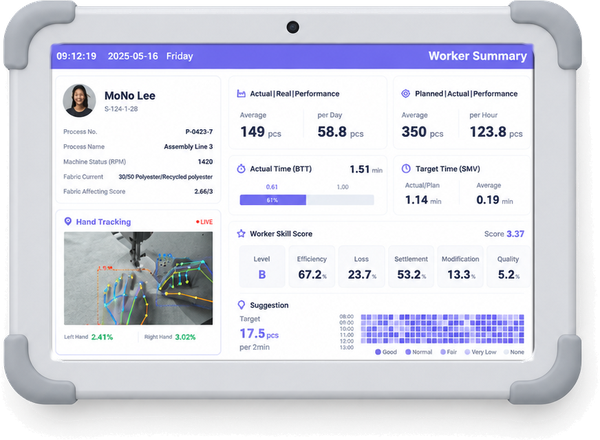
IoT smart factory solution on each sewing operator table. Measures cycle time, productivity per operation, and runs forecasts and simulations.

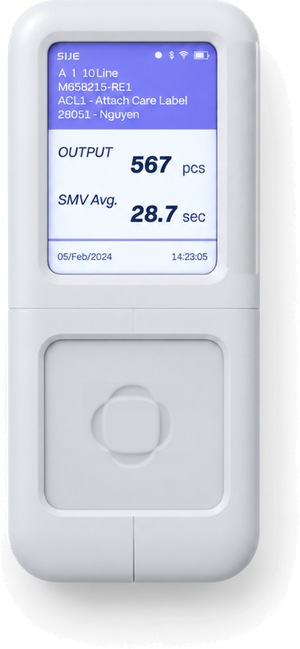
Monolog V1 device top-view pictogram (screen lights up on hover)
DEVICE VER.
Device Ver.
Sewing Machine Vibration
Monolog V2 tablet top-view pictogram (screen lights up on hover)
TABLET VER.
Tablet Ver.
Operator Hand Motion
Measured ItemOutput per operation, cycle time, line uptime/downtime
Install UnitPer sewing operation. No machine replacement
LinkageMeasured time (AMV) feeds Monolis cost standards

CM designed before intake sets both the quote basis and the production target.

Planned pre-costing, confirmed pre-costing and floor measurements are connected as one set of data.

O5 // KNOWLEDGE ASSET

Every Order,
A Layer

Knowledge as an Asset

When an order closes, the operation knowledge, fixes and plan revisions gained along the way scatter.
They stay in personal mailboxes and folders where no one else can find them, and when the person in charge changes, they must be built again from zero.
When an order closes, operation knowledge, fixes and plan revisions scatter across personal mailboxes and folders, and must be rebuilt from zero when staff change.

  1. 5-AWhere Knowledge Sits Now
  2. FIG.Measured, standardized, related, reused
  3. 5-BHow Knowledge Serves the Next Order
  4. SummaryCompany Decision Criteria That Outlast Staff Changes
5-A. Where Knowledge Sits Now

Knowledge Lives in Individuals

Staff remember how many minutes an operation takes and which fabric caused trouble on which line.
That memory remains only as results in quotes and work orders. The reasoning is not recorded.
After a staff change, a repeat style is handled like a new one.
THE STACK

Standardized, linked measurements
become operating assets for the next order.

Measured, standardized, related, reused
CLASSPROPERTYORDERSTYLESMVYIELDPQCDLAYER 00MEASUREDIoT Production Data Capture

Values from lines, operations and machines are collected as measured.

LAYER 01STANDARDIZEDStandard Concepts and Attributes

Factory data is standardized by class, instance and attribute.

LAYER 02RELATEDDefined Context Relations

Operations, materials, machines and people are linked in context.

LAYER 03ASSETCompany Operating Asset

Stored relations and context are reused to source the next order.

LAYER 04AI AGENTComing Soon

Agents decide and act on the knowledge asset.

CLASSPROPERTYORDERSTYLESMVYIELDPQCD0001020304
  1. 04AI AGENTComing Soon

    Agents decide and act on the knowledge asset.

  2. 03ASSETCompany Operating Asset

    Stored relations and context are reused to source the next order.

  3. 02RELATEDDefined Context Relations

    Operations, materials, machines and people are linked in context.

  4. 01STANDARDIZEDStandard Concepts and Attributes

    Factory data is standardized by class, instance and attribute.

  5. 00MEASUREDIoT Production Data Capture

    Values from lines, operations and machines are collected as measured.

5-B. How Knowledge Serves the Next Order

Past Order Results Back the Next Quote

For the same or similar styles, past actual labor time, efficiency, output and fix history go straight into the quote.
Stored values, not staff memory, become the quote basis.
Each order makes the basis more precise, and the record becomes a company asset.

AMV per Operation

Basis for SMV and line targets.

Style Difficulty

Starting point for similar-style quotes.

Machine · Labor Data

Basis for line balancing and staffing.

Issue and Fix Log

Prevents repeat defects.

Company decision criteria that outlast staff changes.

Measurements and relations from every order go into a sewing-specific data dictionary that backs the next order.

Explore the Products